In Search of Roots [This is a 2007 enlarged edition of an article I wrote in 1996].
On Tuesday 2 July 1996 I travelled by car to the five main places (situated in what is today Belarus) mentioned in Uncle David’s manuscripts that make up the 1996 book MY FAMILY. The five places are situated in the area about 250km (150 miles) south- west of Minsk in the direction of Brest-Litovsk which is on the Russia-Polish border. With my driver and interpreter I started from Baranovici and visited (and sometimes had to search hard for) Buten, Sventaia-Volia, Khoshike, Bereze and Swalbitch. We finished up at Minsk, having travelled about 350 miles.
I had been with a group from the Spiro Institute on a tour of Lithuania and Belarus organised by Jack Kagan, who was born in Belarus and who fought with the partisans in the forests of Belarus during WW2. I took a day off to find the original homes of my family of over 100 years ago.
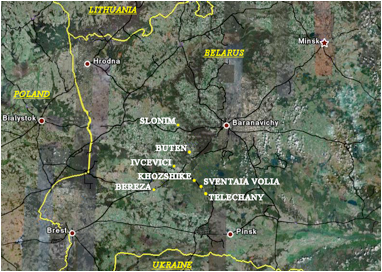
This map is superimposed on a modern satellite photo.
Until about 1990 Belarus was part of the Soviet Union and known as Byelorussia. ”Byelo” in Russian means white. . It is in area a little larger than England, but with about one-fifth of our population. The Soviet authorities attempted to destroy as much religious, including Jewish, history as they could. Belarus became an independent Republic in 1991.
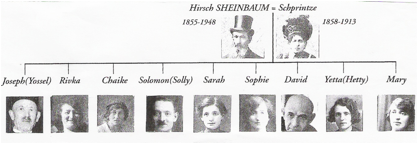
Family of Hirsch and Sprintzer Sheinbaum all of who were born in Belarus
The cost of the car, driver (Andrei) and interpreter (Nikolai) was 3,200,000 Roubles (!) about $200 or, then, £130. My driver and interpreter were very nice people but not much good at map-reading. Soon after we started off I tried to explain that either the sun was in the wrong place or we were going in the wrong direction.They did not understand what I was getting at but after about 25 miles they turned round and backtracked! A problem was that David had used the Yiddish form of place names which generally bore little resemblance to the sound or spelling of the place in Russian. But Nikolai was expert at finding very elderly people who could remember the period between WW1 and WW2, and they were the ones who could give us information about the places and people.
BUTEN [Chapter 3 of My Family.]
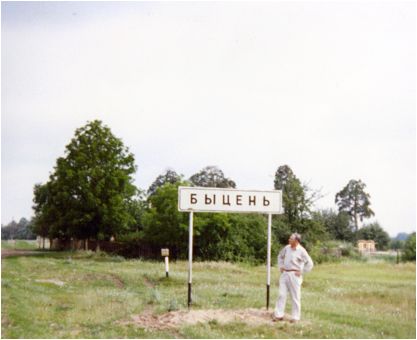
This was the first and most successful visit. A crowd of elderly people quickly gathered around us. As soon as I mentioned the name Rabinowitz they all reacted in recognition. We must remember that David was writing about a period more than a hundred years ago, so the people they would know about were the children or grandchildren of the people in the book. They me to the Rabbinowitz house where David said it was [page 58], but it was not as grand as he made it out to be 100 years ago. David was very young when he knew it and, like a fisherman and a fish, it grew in the retelling. It was a solid stone house and so survived, and is now a shop. Its address is 75 Sovietskaya Street. Two of the people said (independently of each other) that I looked like the Rabbinowitz family. The people they remembered there would have been my second or third cousins.

[House in Buten where the Rabbinowitz family lived (page 58).]
It is now a shop and much changed from David’s day over 100 years ago. It is on the site described by David but it is probably now a new building.
They referred (before I mentioned the name) to the house where the Pitkowsky family lived. It was a wooden structure but nevertheless survived. They mentiond names like Mushka, Abraham and Leib as living there in the past. From Chart 10 in my 1960 Book of the Family, it can be seen that during the second half 19th century Samuel Pitkowsky married Schprintze Rabbinowitz, daughter of my great-great-grandfather Rabbi Moses Rabbinowitz (1817-1893). The chart shows that Samuel and Schprintze Pitkowsky had a son Isaac, who lived in Buten, and he had seven children including three named Moses, Abraham and Libe. These third cousins of mine may well be the Mushke, Abraham and Leib they referred to.The people we spoke to referred to their previous Jewish neighbours in a very friendly way.
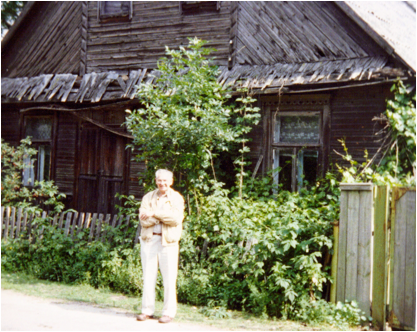
[The house where the Pitkowsky family lived.]
It looked as if it was the original house. The Pitkowsky family between WW1 and WW2 would have been my third cousins with the common ancestor Rabbi Moses Rabbinowitz (1817 – 1893).
There was a reference to a neighbour named Baruch. This may be the Baruch Bereskin of Buten who married Chinke, daughter of David Rabbinowitz (1833- 1890). The Baruch they mentioned would have probably been their grandson, or my second cousin. They also mentioned in this context the name Chinke who may well have been given her grandmother’s first name.
They also mentioned Leon and Rosa Rosenblum, children of Hirsch (I do not know those names). Rosa had studied in Warsaw. During the “Polish” period she taught Polish in Buten, and when the Russians took over she taught Byelorussian. She was killed by the Germans (or by their Lithuanian or Ukrainian assistants who did so much of the killing for the Germans – or for themselves!).They also mentioned names like Ulievsky and Shurubsky (with family in Israel).
I asked about the Water Mill [page 56]. They looked doubtful but then one old lady remembered and took us to a place where the remains of what could have been David’s water mill could still be seen. Only some foundations were left but one could see that it could have been a water mill because of the artificial drop in height of the small river at that point. It also fitted David’s description of the location (but at the wrong end of Buten!).
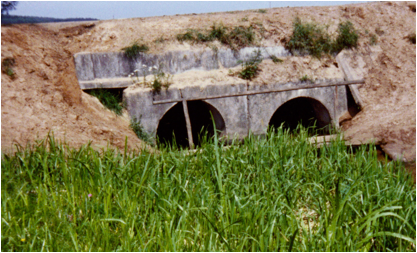
I was told that this is where the old water mill used to stand. It may well be the one David passed on his way to Buten. It fits his description but he probably entered Buten from the south and this was on the north side!
They pointed out where there had been two synagogues close together. One, they said was for the “jumping Jews” (which I took to mean the Hassidic Jews!) and the other for what they called “normal” Jews. David mentions the two synagogues (Page 59). They said there was another synagogue in another part of Buten and all three had been destroyed or put to other use.
All the Jews of Buten were killed during WW2 by the Germans or their Lithuanian or Ukrainian assistants. They showed me the large field where they had been killed and buried. Over 50% of Buten had been Jewish but there are none there now.

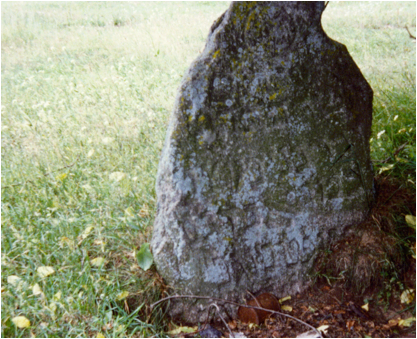
[Tombstones at the very old cemetery just outside Buten.]
I also saw the old Jewish cemetery just outside Buten (it may be the one David mentions on page 56). It was in a large unfenced field. The tombstones were very old and all had partly or entirely collapsed and many were covered in foliage. The tombstones all bore inscriptions in Hebrew but they were so weather-worn that I could not make any of it out. They said this cemetery had not been deliberately damaged – it was the result of time. At the base of this tombstone one could make out some Hebrew letters but it was not possible to read anything.
SVENTAIA-VOLIA [Chapter 4).
It may be appropriate to quote here two paragraphs from the start of Chapter 4 of the book My Family. The chapter is headed Khozshike, Smolne, Sventaia-Volia. David described his journey from his home in Swalbitch to Sventaia-Volia as follows:
To reach the village of Khozshike we had to travel for the most part over the same road which led to Buten, through Bereze and past the railroad crossing until about 15 miles away from Buten.
At this spot we turned off to the right, on a road which ran through the village of Khozshike all the way to the railroad town of Telechan. This was by far the worst road I had ever travelled over, for it was full of deep mud holes and wheel ruts, which caused our wagon to lurch from side to side dangerously and I had to hold on tightly to the sides of our wagon in order not to fall out. On both sides of the road for as far as the eye could see there were bogs and marshes, stagnating pools with surfaces covered with tall reeds and grasses, so that not a sign of water could be seen anywhere. Every now and then we crossed over rotted wooden bridges badly in need of repair, which could hardly sustain our horse and wagon.
The ten miles we had to cover on this road in order to reach the village took us many hours to ride, and in some parts the road narrowed to a mere path which literally squeezed its way through the thickly wooded forest where the thick foliage obliterated the sun, and where the weird solitude and loneliness frightened me out of my wits. It was a hazardous and dismal road without a sign of life anywhere to be seen or heard except for a wild hare or wood mouse which, having been disturbed by the creaking noise of our wagon, darted swiftly across the road and disappeared into the brush.
When, at last the village [of SventaiaVolia came into sight I was very much relieved even though it did not look very appealing. It was very evident that here was a very poor village. The peasant huts were old and dilapidated and hardly any tilled land could anywhere be seen.
Elderly people showed me the site of the Smolne (turpentine factory) which, towards the end of the 19th century, had been managed by grandfather Hirsch Sheinbaum. It had been destroyed during WW2 by Russian partisans (because, I think, the Germans had been using it). There was nothing to see of the original structure but one man said he remembered the “high Columns”. In Belarus today production of turpentine is a major industry.
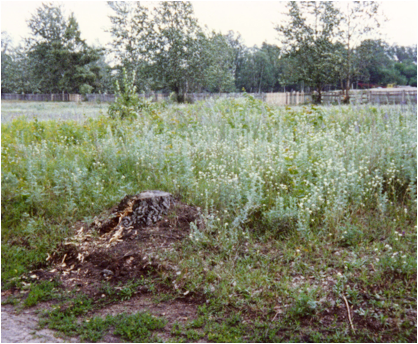
[Site of the old Smolne (turpentine factory) at Sventaia-Volia which grandfather Hirsch managed.{Chapter 4]. |Turpentine is made from the stumps of trees]. Destroyed by Russian Partisans in WW2 while being used by the German).]
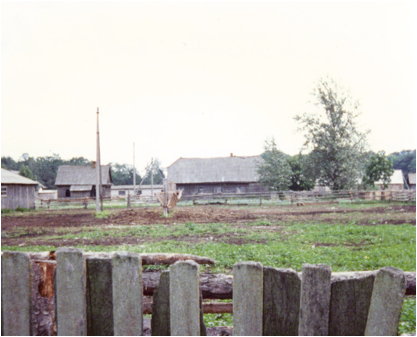
The wooden huts where the Smolne workers had lived could still be seen.
KHOZSHIKE [Chapter 4].
This village lies between Ivcevici and Telechany.The whole Jewish area had been burned by the Germans and nothing of it could be seen.
BEREZE [Pages 52 ff].
This was, and is, a comparatively large town where the family of grandfather Hirsch Sheinbaum came from (the Rabbinowitz family of Buten etc descended to us through grandmother Schprinze). In the time available I could not see any reference to them. But we were able to find out where Swalbitch is!
SWALBITCH [Chapter 1].
A problem was that this was the Yiddish name and the Russian name sounded quite different. Luckily someone waiting for a bus in Bereze recognised the name. It was, in fact, quite near where David said it was. He said that Bereze was about 10 miles from his home (in Swalbitch), and Swalbitch is in fact about 10 miles south-west of Bereze.
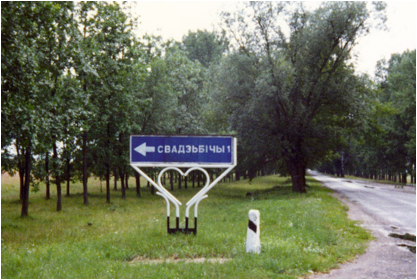
Signpost leading to Swalbitch (page 10).
The actual Russian pronunciation would be something like SVADZBICHI.
Swalbitch was the birthplace of my father Solomon, and all his brothers and sisters except Yossel (Joseph) and Rivke who were born in Bereze. It is a small farming and cattle village. All my family had left by about 100 years ago, and the name Sheinbaum did not mean anything to anyone. One old man said he remembered the name “Zweibaum” but if he meant Sheinbaum I have no idea who it might have been. They said the Jews “were not rich and worked very hard”. David said they had a much higher standard of living than the neighbouring peasants (but that was over 100 years ago).
I was shown the field outside the village where there had once been a “post-station” (page 15) and three houses, where travellers would rest and change horses. It was beside the road but completely destroyed and grown over. David said their home was close by the post-station and served as an inn (pages 10 and 12).
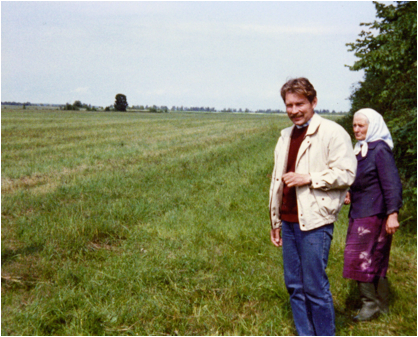
Site where the post station used to stand. (p.19). Nikolai, my interpreter. The lady is one of the elderly people who could remember the period between WW1 and WW2 .
I asked about the smithy (page 15) where Velvel made horseshoes. Someone said “of course” meaning there would have to be one there (but Velvel would have been long dead).
An old lady said that all the Jews had been taken from there to Berece where they were murdered. She said they were buried “without care – hands and legs sticking out...”.
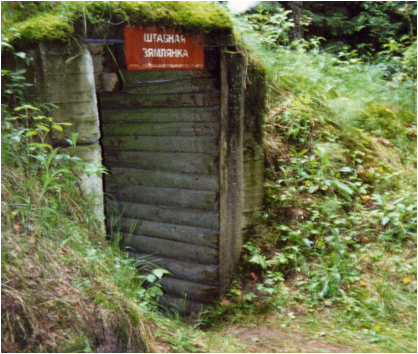
[Entrance to underground “barracks” in Byelorussian forest where Jewish partisans lived.
Jack Kagan fought with these partisans.
LITHUANIA.
In Lithuania I visited with the Spiro Institute group Kovno (now Kaunus), the Ponar Forest, and Vilna (now Vilnius). In Kovno in 1941, when the Germans occupied the town, there were 40,000 Jews. The Jewish inhabitants were forced into the Ghetto in the poorest part of the town. Ephraim Romm, then only 15 years old, survived and his description of the terrible things that happened includes the following extract:
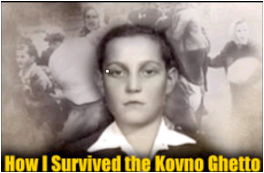
....Other than the searches at night, the Germans would also have sudden Aksionnen during the day. One of these was the children's Aksionnen in which they collected all the small children who were still alive in the Ghetto and executed them in the Ninth Fort (an area near the Ghetto where most of them had lived).
The Ghetto's inhabitants were killed during the three years the Ghetto was in existence.
In 1943 the German army was badly defeated at Stalingrad and the Red Army was approaching. According to a diary of a local Polish resident, Kazimierz Sakowicz, he heard and saw as tens of thousands of people, mostly Jews, were shot and piled into pits in the Ponar forest near Kovno.Sakowicz’s diary portrays an image of life in a quiet agricultural village, while mass murder is carried out in its backyard and the residents become collaborators.
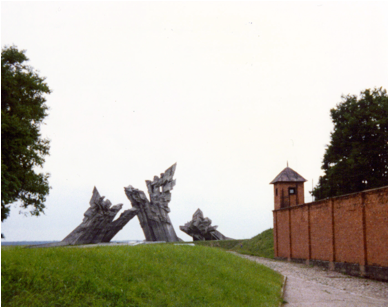
Corner of Fort 9 at Kovno and the Russian memorial.
Jews from France (Drancy) were held here and then murdered.
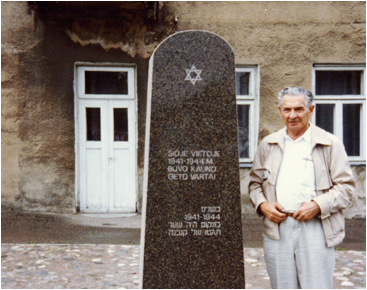
Momument commemorating the Kovno ghetto.]
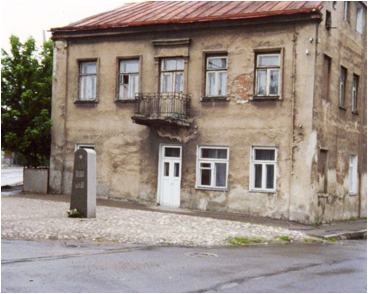
Building at entrance to Kovno ghetto. It was instituted in 1941 to concentrate Jews before taking them to labour camps or execution – or both
Monument at Ponar Forest, Lithuania, commemorating murder of 30,000 Jews.
As far as I am aware we had no close relations in Lithuania but we visited the reputed tomb of the “Vilna Gaon”, Elijah ben Solomon Zalman. His father Gaon Reb Solomon Zalman, twelve generations back, was one of our ancestors.