Business History of Cyril Sherwood and Woolf Marmot – (First written Feb 2003).
I have been asked to set out the history of my business relations with Woolf Marmot. If I include all the history of those times it will go on for ever. There is a lot of background, which might (or might not) be interesting, that can be added later if desired. In this aspect of my history I do not deal with my previous history, or any of the incidental history and people, except insofar as it was directly relevant to the business history.
If anyone is interested, the 7 hours of CDs made by the Archive Division of the Imperial War Museum describe in some detail my life from birth in 1920 to 1940, in great detail my 6 years in the Army to 1946, and a sketchy description o the period after 1946.
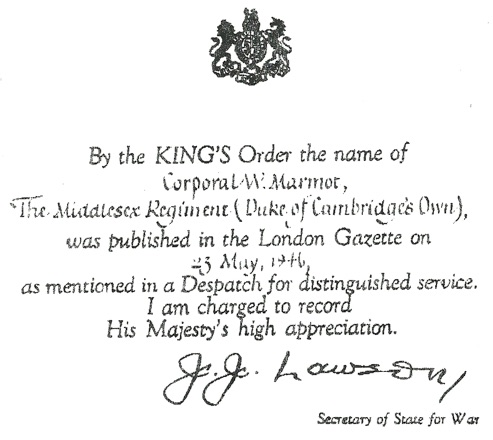
Although Woolf and I had known each other since the 1930s our business connection started about 1960. Woolf and I were both born in 1920. Woolf had left school after he matriculated at age 16. When WW2 started he spent six years in the army; he was wounded at Anzio in Italy and was "Mentioned in Despatches".
In 1945 at the end of the war he was stationed in Palestine (the part that is now Israel). I was in that area of the Middle East at the same time and we used to meet whenever possible. In Palestine he met his future wife Hélène (I had also met her and it is still a standing dispute about who met her first). Helene was born in France and though Jewish she and her mother managed to survive the German occupation there during WW2. Woolf and Helene married in London in 1947 and in 1948 went to live in Paris where Woolf started a job with an American company that manufactured one of the first ball-point pens. The company was called Reynolds, and that name has stuck. The pens were rather famous for their advertisements claiming they could write under water. The problem, I gather, was making them write in the air. Woolf’s job was setting up the production of the pens in factories all over Europe, and trouble-shooting all their problems. It was while he travelled and worked in many European countries (he and Hélène lived a year in Holland), that Woolf picked up his expertise in international business, his ability to make good contact with people of different backgrounds and different cultures, and learned to converse in a variety of languages. When the Korean war started, shortages of a number of industrial items arose in America. Woolf and his American partners started a company called Reynolds Fasteners to procure fasteners (nuts and bolts to us) and other steel items, manufactured in Europe for export to USA. It was Woolf’s job to organise it all from Paris.
During the latter part of the 1950s problems arose between Woolf and the Americans, and he decided to work on his own. As part of the separation deal Woolf was allowed to keep the name Reynolds, and that is how Reynolds European Inc S.A. (which we can call Reynolds Paris) was born. At that time France was in the centre of the new Common Market and the New Europe, import duties were tumbling down and many other European countries were keen to supply their production in France. The expertise Woolf had gained in international business, his extremely good organisational and business ability, his ability to get along with people and in particular his ability to get good terms from his suppliers enabled him, by the end of the 1950s, to have developed a thriving business (with Holland, Germany and Belgium etc) of importing and distributing in France "semi-finished non-ferrous products" such as copper tube (for water and central heating), brass rod (for the lathe "turning" industry) and aluminium sheet etc etc.
In the late 1950s I was working in the family business of Bishopsgate Motor Finance Corporation Ltd and Stanwood Motor Finance Ltd, situated in London. My father had gone into the Motor Finance (Hire Purchase) business during the 1930s, and kept it ticking over during WW2. When my brother Ian returned from four years in a prisoner of war camp in Germany he entered the business and, in effect, took over running it. My older brothers Moss and Joss were chiefly involved with their smoked salmon business which my father had started around 1920. In 1948, after six years in the army and two years further study I was called to the Bar in 1948 where I practised, with only moderate success, for several years. In the early 1950s my father developed heart problems. I used to go occasionally to the business to help out and gradually found I was going there more and more often and spending less and less time as a barrister. From the mid 1950s I spent all my time at the business. I quickly learned what to do and as quickly became bored with it.
I think the main reason I wanted to change my direction was that there were many developments taking place in Europe. Common Market (the precursor of the present European Union) was developing and it was assumed Britain would join. I felt that the world was moving on and I felt I wanted to move with it. I accordingly gave notice that by 1960 I intended moving out of the business. The business was quite routine and narrow so I had gained very little real business experience, and they predicted calamity for me. Objectively they were perhaps right in their reasoning, but wrong in the result.
At that time it was fully expected that Britain would join Common Market. Woolf thought it would be a good idea to start in London a similar business to what he had in Paris, to take advantage of the changes there would be. Although import duties into Britain were very high at that time, and trade between Britain and the Common Market countries was very difficult, the duties would come down in due course when Britain joined. The London office would be able to take advantage of the business relations Reynolds Paris already had with Common Market countries. Woolf knew I intended leaving the family business. He phoned me and within a few minutes I said yes. I would start a company in London in partnership with Woolf and we would take it from there.
In 1960 I left the Finance business. I should mention that at that stage I was a bachelor, so I did not have the burden of responsibility for others. I cannot say what my decision would have been if was married and had children.… The money I had saved and what I got for the shares I had in the Finance Companies was very small by today's standards but was enough to keep me going for a while. I incorporated Reynolds European Inc (London) Ltd (we can call it Reynolds London) with two thousand £1 shares, issued 1000 to Woolf and 1000 to me. At first I worked from my home in Canons Park, Edgware, London but immediately started looking for an office.
There was a choice of offices. One was sharing an office in Holborn with a small firm of solicitors, utilising the same office staff. The other was a much more expensive office to ourselves in Berkeley Street, Mayfair.
I was more cautious and was disposed to take the office in Holborn but after discussion with Woolf we decided to go the whole hog and start at the highly prestigious office in Mayfair. It was the right decision.
I started out with a staff of one girl typist. There were three rooms. I used two rooms and managed to sublet the other room to an American company who were involved with something I had never heard of called "Critical Path". It worked out well as the rent for that room actually paid the rent of all the three rooms! A few years later I took that room back and a few years after that I took over the other three rooms on that floor of the office building. In 1967, when our shares in Reynolds London were sold to my main supplier (more about that later) I took over the whole floor of a prestigious office building overlooking Buckingham Palace.
I remember one of the first attempts at business was trying to export square brass tube, manufactured in Birmingham, to Reynolds Paris, but for whatever reason it did not work out. In any event trade in these non-ferrous semis (the items Woolf dealt with) between England and the Continent was very difficult because of the high import duties. Also UK was one of the world's main manufacturers of these items. We put all our failures down to experience, while waiting for England to join Common Market. To keep going in the meanwhile we tried a wide range of possible business, from One-Day insurance policies to be sold from machines in garages, to the equivalent of "tout pour dix francs" stalls in markets all over Britain. Attempts to import aluminium sheet from Belgium and aluminium "cire perdu" electronic components from Canada and many more, all of which came to nothing. We did manage to ship a few loads of waste paper from France to England but when millions of bricks were needed in England because of a sudden acute shortage we were unable to organise supplies. So, the first couple of years were very difficult and at times I became very pessimistic. Very frequently I would arrive at the office to have no post except the magazine "Metal Bulletin". It was painful to have to pick up the phone and speak to someone who had already said "no" three times, and at times I became quite despondent.! However although I had previously had no actual business experience I found I was learning at a fast rate and this was to be very useful later. My savings were fast disappearing but we were still optimistic that our entry into Common Market would solve it all.
I then had a stroke of luck. A friend of Woolf ‘s, an Italian named Augusto Mascioli, introduced us to an Italian Company named Simmel who were situated in Castelfanco Veneto in Northern Italy. I should mention that although Woolf had left Reynolds Fasteners after disputes, he still retained close relations with some of them, particularly Benny Krieger of New York (Benny was, I think, also an Israeli). Simmel was an engineering company that manufactured spare parts for tractors which were sold in competition to the tractor companies' own (more expensive) spare parts. The parts were all those components that produced the traction, i.e., the chain that was made up of the flat plates that supported and drove the tractor, the links that held the plates together, the sprockets and idlers etc. They were made to exactly the same specification as the OEM (Original Equipment Manufacturer) spares and were (probably) just as good). The tractors were Caterpillar, Allis Chalmers, International Harvester, and Massey Fergusson etc. There were a large number of these "nonOEM" manufacturers in USA but outside USA Italy had somehow become the main supplier. Simmel was probably the second largest in Italy.
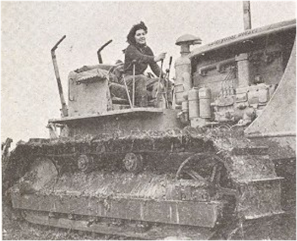
Caterpillar Tractor driven by Land Army lady during WW2. The
parts we dealt with were
Track Plates, Sprocket, Roller and Idler.
Woolf, Benny and I visited Simmel and got the agencies for France, USA and England. There were several non-OEM distributors in England and it was not too difficult developing some sales. In London it was in effect the only business I had, but in France and in USA it was only an incidental additional business. The plan was to . sell £100,000 in England and my commission was 5%. I calculated I could just about manage on this income of £5,000 per year! My company expenses were about £2,000 - £3,000 and I reckoned I could just about manage on the balance. (£2,000 then was about £20,000 today). The difference in price between the OEM and non-OEM was extremely high - the official manufacturers kept their spare part prices very high (using their guarantee as an inducement), so the import duties from Italy could be absorbed. It was not only a good business for me, but also a pleasant one. Woolf, Benny and I would meet in Venice, spend the night at a good hotel (Benny always insisted on "the best"), and the next morning we would go by gondola (with our brief cases but no bowler hats) along the Grande Canale to the car park where a car would await to take us on a beautiful drive up the lower slopes of the Alps, to beautiful Castelfranco (the birthplace of Georgione). The Guinness family had a home there. A few hours at the factory and then a super lunch where I learned a great deal about the specialities of Italian cooking. Then a rewind of the morning's trip back to the hotel (I think it used to be Hotel Danieli). Sometimes I would return home to England via Milan from where I would go skiing in Cortina D' Ampezzo with an Italian lady from a very aristocratic Italian family whom I had originally met at the Hampstead Theatre in London. Remember, I was still a bachelor at that time.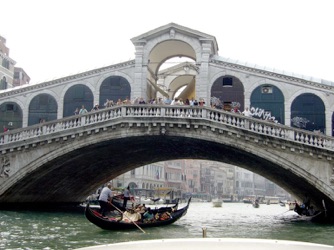
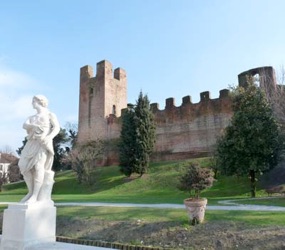
Rialto Bridge Castel Franco, Veneto
Mascioli also introduced us to other Italian companies. These included a company in La Spezia who made gear boxes for cars like Ferrari etc. We visited the Ferrari factory in, I think, Modena. I negotiated with Jaguar and Ford in England. I had an appointment with Ford and the following day with Jaguar. At the end of the Ford appointment he wished me luck with Jaguar. My secretary/typist had put the letters of confirmation about the meetings in the wrong envelopes! At the time I did not mind Ford knowing about Jaguar but did not like Jaguar knowing about Ford. I need not have worried. There was no chance of business developing. In those days the markets were very well sewed up. Incidentally, I think it was at that La Spezia company that the Director of Sales was the famous Stephanini who, during WW2, had been deeply involved in producing the Italian two-man mini-submarines that wreaked havoc with the British fleet in the Mediterranean. Another company was Ellettrodomestici who made kitchen "white goods" like refrigerators. This also got nowhere. What was interesting was that the Italians had introduced the system of keeping fridges sealed closed by magnetic strips instead of the plain rubber strips used in England. This was too big an advance for Britain at that stage although it became the accepted system later. I tried marketing sphygmomanometers (blood pressure measuring) in UK. They were very glamourous with "advanced" methods but quite wrong for the UK market. They had to be packed carefully in a special box after use but UK doctors could not be bothered with that. They wanted a system they could use quickly and then throw into their bag. Britain was a hard nut to crack as far as imports were concerned. Later the "Inc" was dropped and we became Reynolds European (London) Ltd.
Everything I attempted to do involved discussion with Woolf and advice from him. From leaving school, at the age of 16, and certainly since the end of WW2 in 1945 Woolf had been involved in business of one form or another. I was a complete beginner. I had studied law and had been a barrister for some years. As far as being a barrister is concerned I was not the worst, but I was far from the best. Many people told me they assumed my study of law was useful training for business. My answer was yes and no. Yes because it was useful to enable me to collate relevant factors (natural business people do this automatically) but No because it made me see too many sides to a problem, thus making decisions harder. When I told Woolf could see a problem from the customer's point of he used to shout, "I don't want to see it from the customer's point of view!". Of course Woolf always did, because otherwise he could never know how to solve the customer's problem within the range of what his supplier could be made to do. Benny Krieger used to say that I saw so many aspects of what could go wrong that he could not see how I would ever close a deal! He was wrong. You have to be strong enough to go ahead even if you know the measure of the problems.
The years 1962/1963 were tough and things started to happen fast. I cannot set them out entirely in chronological order but they were as follows:
1)Britain had applied (under Prime Minister Heath) to enter Common Market. Suddenly, with no warning, De Gaulle (President of France) said his famous "Non". Britain, he said, was not yet ready to take part in the new European entity that was being formed. This was a massive blow to me as most of the previous years' preparation had been on the assumption we would go into Common Market, where elimination of import duties would permit Britain, as it did with France, to develop trade with the main European countries.
2) The Italian Company Simmel was taken over by the tractor manufacturer Massey Fergusson, who would henceforth use their own branches in UK, France and USA, as sales outlets. We tried to retain the agencies but without success.
3) About this time an event occurred that was to transform my business activity for the rest of my business life though, of course, I had no idea of that at the time. In 1963 an acquaintance of Woolf in the metal world (an Austrian named, I think, Denley) mentioned to him that there was a copper company in Finland named Outokumpu who might be interesting for us. Woolf paid them a visit and some business developed between Outokumpu and Reynolds Paris. I went to Finland, carrying an order for three lots of copper tube and the rest, as they say, is history.
I must explain Finland's background. Over the centuries there had been a long history of antagonism and fighting between Finland and Russia. From 1815 to1917 they were a part of Russia, but then gained their independence at the time of the Russian revolution. During the late 1930s there was a war between Finland and Russia, and Finland lost part of her territory. When Germany went to war against Russia (in 1942) Finland joined with Germany (though refused to treat the Finnish Jews the way the Germans wanted). German forces occupied Finland. Later in the war, when Germany was losing, Finland switched sides and the Allies' requirement was that the Finns destroy the German army in Finland. As the Germans retreated they destroyed as much of the Finnish towns and industry as they could. Finland and Russia by then were nominally on the same side but when WW2 ended Russia required the Finns to pay them very large reparations for their fighting against the Russians earlier in the war.
Finland's traditional industry was almost all based on their enormous forests - wood and paper. During the 20th century, and particularly after WWl, they had developed their industrial and technical abilities. Their education had been based on the German system which enabled them to develop one of the highest levels of education in Europe. Early in the 20th century nickel had been discovered in North Finland (some of these mines were expropriated by Russia). Furthermore, and this was most relevant to me, in 1910 their first copper deposits were found. Later zinc, cobalt, ferro-chrome etc were mined. During the years after WW2, their copper industries were developed - to some extent this was to enable the Russian reparations to be paid. Their technical abilities developed enormously, and they began producing quality as good as, and probably better than, other European and world manufacturers of semi- finished copper. In most people's minds, however, they continued to be considered an offshoot of Russia and of little interest to the rest of Europe and the world. When I later approached people most had no idea where Finland was and assumed it was part of Russia, which at that period of the cold war was almost an enemy.
Soon after WW2 ended, the "cold war" started and although Finland was nominally independent her treaty obligations with Russia prevented her having any political relations with other countries. As Common Market was nominally trade it also had political intentions so Finland could not join them. However around 1960 The European Trade Area (EFTA) had started. EFTA comprised mainly the European countries that had not, for one reason or another, joined Common Market. It thus included UK, Sweden, Norway, Austria, Switzerland and Finland. Import duties between those countries were dropping towards zero. UK industry, I reckoned, was the biggest by far in EFTA, about 50% of the whole of EFTA. Finland had recently finished paying Russia her reparations (Russia had required Finland to pay largely in industrial production and this had the effect of developing her technical abilities even further). My reasoning was accordingly that the Finnish copper industry must inevitably sell to a large extent in UK. It became clear that this was also Outokumpu's reasoning.
Right from the start I got along very well with the Finns. Previously their only experience outside their home market of Scandinavia was selling their raw nickel and copper cathodes through brokers in Germany. I think they had very little experience with any other foreigners - and much of what they had was unsatisfactory. I think their lack of experience in international marketing left them a prey to dealers who took advantage of them. Thinking back, I think the reason they relied so much on me, and also trusted me, is that they considered me an intelligent and capable person they could get along with - but who was not "clever" or cunning. It all went very smoothly from the start. The Finn I was most involved with was Jorma Hakkarainen, the deputy Commercial Director of Sales. I quickly developed an excellent "rapport" with him and the other sales people. It also went very well with the technical people at the works - perhaps because I originally had wanted to be an engineer and so was interested in, and could understand, their problems. I was quite good at getting customers to co-operate in sorting out technical problems. And furthermore, the speed with which I could open up new markets for Outokumpu’s production made them feel I was the man for them.
Within only a few years we had a portfolio of top-level customers of whom any manufacturer would be proud. These customers were firms where quality, service and reliability were the prime considerations - and where price was almost secondary.
Reynolds London somehow developed a reputation, among our customers as well as with Outokumpu, of extreme efficiency. (I used to say that we were not particularly efficient but that others were so inefficient). Also, perhaps because of my innocence in the traditional ways of trading, we were thought of as having introduced a new aspect of marketing!
At the start the only item I supplied was copper water tube. This was where the bulk in tonnage was but where the "added value" was quite low. Outokumpu refined the copper that they themselves had mined and was almost the only company in the world who controlled all the refining and manufacturing processes themselves. They had developed a refining process that is now used by practically every refining company in the world. They were able to produce a "certified oxygen-free copper" of a quality that was only produced in the USA and which was vital for many essential electronic purposes. I gradually entered the more sophisticated (and difficult) world of higher technology. When there was a longshoremen strike in USA which closed all their ports I was, in effect, the only person in UK who could promise a delivery of particular types of copper, and later of nickel, and the customers knew I could keep to my promise. In time I became a supplier of a large proportion of the "special" items needed by, for example, large turbo-generators for producing electricity, copper strip for transatlantic underwater cables, copper hollow conductors for the cyclotron at CERN, very special copper for BBC transmitting valves, nickel cathode for very, very special electronic purposes etc etc etc. It was all very interesting - and quite profitable for the three parties involved, the customer, Outokumpu and me.
What Outokumpu also needed was an agent who provided quality, service and reliability. They found this in me and, accordingly, the price they paid was secondary. I think it is true that they paid me more, perhaps considerably more, than they would have needed to pay elsewhere. Not long after I started working with Outokumpu, a well established firm of importers and distributors tried to get them to change from me to them. It is a tribute to Outokumpu that they had sufficient confidence in me to refuse. I think that Outokumpu would not have done as well in UK if they had switched. After working with Outokumpu for a few years Reynolds London started to become very profitable. Outokumpu could calculate, and no doubt they did, just how much we were making but they raised no objection. I think they did not know how low I managed to keep our expenses. We were a small company but we got through an enormous amount of work very efficiently. We were never a very large staff and (almost) all of them were extremely loyal and hardworking. The problems Woolf and I found most difficult were problems involving staff - and particularly between staff. We both hated having to discharge someone, even when it was quite justified. All my dealings with Outokumpu were completely above board. Any errors they made commission I immediately corrected - particularly when it was in my favour. At one stage, when I was purchasing on my own account, I owed them a very large sum of money, and it was owed purely on my own signature - no bank guarantee or anything. When I told my father about this he said either they trusted me very much or they were not good business people!
Even when I was committed to working in Outokumpu's particular field Woolf and I were able to do profitable business that did not conflict with Outokumpu. The international business we were conducting and the good relations between Reynolds Paris and Reynolds London permitted us both to benefit from our businesses.
At first, as I have said, I purchased on my own account. The number of invoices I issued was not very high but each was for a large amount, so quite quickly I was owing large sums of money to Outokumpu, and I spent a lot of time on financial matters and not actually selling. Fortunately I received payment early from my customers so I had a "positive" cash-flow. I was quite open with Outokumpu about my selling prices so they knew how much I was making. After a couple of years of self financing I felt I would be happy if, instead of purchasing from Outokumpu, I became their representative and received some sort of commission. I said nothing about it but one day, on a train journey with Jorma Hakkarainen and the Director of Sales, Mr Erkki Valve, Mr Valve suddenly said that henceforth I would be their representative. Perhaps it was the way he put it that, although it was what I really wanted, I got very angry and told him that he could suggest what he wanted me to do, but could not just tell me. The rest of the journey was very cold. Jorma Hakkarainen later said that Mr Valve was not used to being spoken to like that (I mumbled something about neither was I ) and and that Mr Valve did not mean it the way I took it. Anyway I did become their representative. Mr Valve said I was too proud and I think that, perhaps for that reason, the commission arrangements were made quite favourable to me.
To revert to the period soon after starting with Outokumpu, certain decisions had to be made. The Simmell tractor business was lost . The question was whether I should try to keep Outokumpu as one supplier among several or concentrate entirely on Outokumpu. Woolf’s business was clearly developing in a way that would involve a number of suppliers. He bought wherever he could obtain the best terms (that was one of his many good abilities) and his business was developing very well indeed. His office and staff were growing far bigger than mine, he had his own warehouses with a far larger number of customers than I had, and his business was far more complicated. Sometimes difficult, and even unpleasant, problems developed between Woolf and his suppliers, and I felt he was more capable than I would have been in dealing with them. Woolf would have preferred that I remain independent but he left it up to me to decide.
During the first few years in business, whenever a problem arose, I would wonder what my father or Woolf would have done. I don't know the exact date but one day I told myself that was no good. For better or for worse I must do it my way. And from then on it was in fact much easier for me to make decisions. Although I asked for other people's opinions I think I always finally made up my own mind.
The normal rule was not to put all your eggs in one basket but it soon became clear that Outokumpu's business would grow to an extent where I could not treat it as one supplier of many - and I was sure Outokumpu would not allow it that way. They said they had turned down an offer by a large company who offered to put a whole division at Outokumpu's disposal. At a fairly early stage in our association Jorma Hakkarainen had said he thought this could be a life-long job for me. I thought to myself that was unlikely as I knew most of these agencies often fizzled out after a while. I think that even at an early stage Outokumpu may have had in mind ultimately having their own sales company in UK...
I think I had a pretty good assessment of my own abilities and weaknesses. I think I knew where my strengths lay. I found that I could generally convince customers that it was in their own interest to buy from Outokumpu. This was never just a one-off basis. It was only where I had calculated that it was in both the customer's real interest and Outokumpu's real interest to do business together in the long term. This meant it was also in my own real interest. It worked well in practice. I would select from research which were the best companies (best also in their own interest). I would get experience in that field from smaller companies, then approach the target company. Outokumpu was very happy with this method. In fact at one meeting with an important customer Jorma Hakkarainen told the customer that we did not sell to any customer that came along - we chose who we wanted to supply, almost giving the impression that the customer should feel proud that we were willing to supply him!
Of the two choices, I felt my way lay with Outokumpu as my main, and probably only, business. As the years have passed I still think it was the right decision for me, although Woolf still thinks I would have been better off staying independent. Outokumpu was a company who produced material of very high quality and reliability. They needed an agent who could match their standards. I felt I would be happier working with the people at Outokumpu and the type of customers we would be supplying than joining in the general battle for business that being independent would involve. Horses for courses, they say. Woolf was excellent at that business and I felt sure then that I was not. I still feel sure I was not. There is a chance that I may have made more money being independent but I very much doubt it. I would certainly not have been as happy in my work.
When people heard about how well our relationship went and asked what sort of contract Woolf and I had to govern our business relations our answer was, "What contract!" We never had any sort of “contract” and we made up our understandings as we went along. During the early 1960s, on a train journey in Italy, we drew up (on a scrap of paper) the sort of distribution there should be if and when profits came in. That scrap of paper was the "contract" for many years, though we never thought of it that way. (On that train journey we decided Woolf’s shoes would be better on me and mine on him. Without a thought we swapped shoes!) In the early days when Woolf told the Americans how well the relationship with me was going, their reply was wait until the profits start coming in, the problems would then arise. The profits did come in but I, and I am sure Woolf, would say the problems never did. We had an understanding that it was the duty of the person who owed the other to keep the correct record, and that it would never be necessary for the one who is owed to ask for settlement. When there was any uncertainty about figures it was always resolved in favour of the other! During part of the 1960s and 1970s the income tax burden in UK was extremely high compared with France. In fact as my income increased I had to pay a marginal rate of 98%; this meant that of every extra pound I received as overseas dividend the equivalent of 98p (19shillings and 7 pence in old money) went in tax. If you added charges the accountants made for doing my tax returns I would have been better off not receiving the dividend at all! Luckily the income tax people decided to permit pension premiums paid to Directors to be treated as a company expense. This meant that we could pay very large sums towards my pension scheme at comparative small cost to the company or to me. Although it meant a very great benefit to me (I am still getting that benefit) it did mean a loss to Woolf, but without any hesitation he said we should go ahead.
Developing the business in UK was not always plain sailing. Customers knew that the Baltic Sea froze up in winter, but I assured them that the Finnish ice-breakers could keep all the route open, however hard the winter. The winter of 1963/1964 was one of the worst there had ever been and the ships that were carrying my first orders were stuck for weeks in the ice! During subsequent years when the UK's economic situation was bad very heavy restrictions were put on imports. On at least three occasions the restrictions could have ruined a young business such as mine. When I had survived the first my bank manager assured me it proved the strength of my business.
During the mid 1970s Woolf and I used to guess when we thought Outokumpu would ask to buy Reynolds London. We knew it would happen but, of course, when Outokumpu asked I acted very surprised and doubtful about the idea. I knew for sure that they intended having their own company in UK and that it would be worth their while to buy me than start from scratch. I was then about 55 and it had been my intention to try to retire at about 60. So, I was in favour of the idea and I was not frightened of the problem many people had when they sold the company they had built up and became, in effect, an employee of the parent company. Many people could not fit into the change and it was often disastrous. Woolf, I think, would still have preferred me not to sell but to go independent, but he left it to me. I told Outokumpu I was in principle agreeable but there was then the question of price. My then accountant Julian Pannaman (he was in the same firm that my father employed as accountants over half a century before) calculated a figure of £300,000 that we felt could be justified by the company accounts. When Woolf told his chief manager Marcel Castro what figure we were asking, Marcel said they would never pay it. A few davs later. when Outokumou accepted our figure, Marcel said we should have asked for more! The deal involved Woolf and me selling all our shares in Reynolds London (they did not ask me to sell my holding in Reynolds Paris). A vital part of the deal was their demand that I would continue as Managing Director. As their lawyers said at one meeting, "No Sherwood, no deal!". This was gratifying to hear. The sale went through very smoothly in April 1976. Denis Ross's firm of solicitors acted for us and put on a nice ceremony at completion. 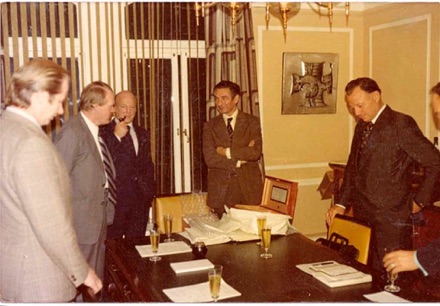
From left to right :
Jorma Hakkarainen, Sales Director of Outokumpu Oy.
Kaukko Kaasila. Managing Director Outokumpu Oy.
Denis Ross, our Solicitor.
Cyril (me)
Woolf Marmot,
(Part of Julian Pannaman our Accountant)
As an example of how generously financial matters were dealt with, although Woolf and I each owned 50% of the shares, Woolf insisted, without any prompting by me, that the £300,000 should be shared 2/3 to me and 1/3 to him. As part of the deal I had to cease working with Woolf on business deals. Woolf and I used to speak by phone several times a day, with frequent meetings as well as holidays together. Although there was no further business connection between Reynolds Paris and Reynolds London (whose name was later changed to Outokumpu UK Ltd) I still kept a direct hot-line by phone with Woolf’s office and we spoke almost as much as before. A problem then arose. Outokumpu and Woolf had discussions concerning a possible sale of Reynolds Paris to Outokumpu. It was clear to me that Outokumpu was determined to have their own company in France and if it was not to be Reynolds Paris they would go ahead on their own. Woolf did not want to sell out to Outokumpu , and I think he was right not to. But Woolf objected to Outokumpu selling in France (to an extent it would be in competition with Reynolds Paris). A dispute arose. It was Jorma Hakkarainen who negotiated with Woolf and they could not get along with each other. It was more than the normal disputes between business people - it became, I think, personal. This put me in a very difficult and delicate situation. I was on friendly terms with Jorma (and his family), and he and Woolf would each often speak to me about their problems with each other. I could not openly take Woolf’ s part but I tried to clear up misunderstandings. In fact I thought and told Woolf, but could not tell Jorma , that Woolf was beating his head against a brick wall. I knew that Outokumpu was determined to have their own sales office in Paris and if they could not do a deal with Woolf they would open their own office whatever Woolf said, and however much it cost them in money or effort. In the end that is what happened and Woolf has never forgiven Jorma! Every now and then Jorma would ask me innocently about Woolf and I had to give half answers. In fact my association with Woolf continued as much as before and he and I frequently discussed all sorts of problems. Although our meetings were really social the Jorma situation was obviously often discussed.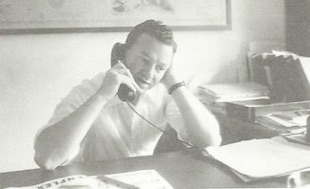
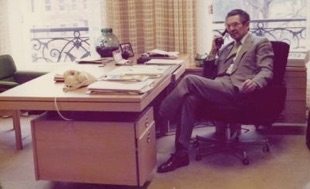
In about 1978 I told Outokumpu that they should think about the succession after me. This would give us all time to train my successor. Outokumpu wanted a Finn to take over in due course and Lasse Pajari came and joined us. In 1981, at the age of 61, I resigned as Managing Director (and in effect retired) and started a very favourable and easy 4 year consultancy arrangement. In 1985 all my formal business connection with Outokumpu ceased and I was a fully retired person. Apart from an occasional social meeting, my friendly contacts with Outokumpu consists of Christmas and New Year cards with a general report about health and what the children have got up to. Birthday cards are sometimes exchanged, especially as my birthday and Jorma Hakkarainen's coincide, with Jorma being exactly 10 years younger. They still send me their Annual Reports and publications.
Outokumpu has grown to be one of the main world mining and metallurgical manufacturing companies, and they have their own sales offices all over the world. I was the first sales company outside Scandinavia that they took over.
During the 22 years of business with Outokumpu I would have meetings in Finland every few weeks or so and I learned a great deal about the country and the people. I was always made most welcome by my opposite numbers at the offices and the mines and factories and in their homes. Their hospitality was excellent. My main problem was coping with the amount of alcohol I was expected to consume! When I retired as Managing Director of Reynolds London, the President of Finland awarded me a Knighthood (1st Class) of the Order of the White Rose of Finland. At that time very few British people had received that honour.
A couple of years before Reynolds London was taken over by Outokumpu I had instituted, for the evening before the main London Metal Exchange dinner, a dinner of our own at the Goring Hotel. It was a sumptuous affair to which a hundred or more important customers were invited. Our Guest of Honour would be either the Finnish Ambassador or Finnish Government Ministers or the top people from Outokumpu's head office in Helsinki. One of the courses was always brought especially from Finland. Our guest list read like the Debrett of industry. It continued for a number of years after I retired and I was always invited, but it ceased when Outokumpu UK moved their head office away from London.
Some years after Reynolds London was sold, Reynolds Paris was sold to a Swedish company for a very large sum of money and I received a healthy sum for my shares. Woolf, in effect, then retired. We had both made and saved a certain amount of money, and the difficult problem arose of what to do with it. Woolf's problem, in that respect, was much larger than mine. The welfare of our families was uppermost in both our minds. At every stage we discussed our plans and even though the legal and fiscal systems in UK and France were different Woolf's advice was of the greatest benefit to me, and I would like to think that some of mine to Woolf was of some value.
Woolf and his wife Hélène still live in Paris, and their family extend over three countries. Somehow, and happily, the relationship and contact between Woolf has remained at least as strong as it ever was, and shows no sign of diminishing.
******************